publications
Here's a record of my published papers. Hoping for more to come!
2026
- Best-of-Evidence: Best-of-N Selection under Partial VerificationCenwei Zhang, Teng Fang, Yuxia Wang, and 3 more authorsarXiv preprint arXiv:2607.20950, 2026
BoN improves model outputs by sampling several candidates and selecting one with a proxy score, but it assumes that complete candidates can be evaluated reliably. Many vision-language tasks instead provide only partial verification: a finding, span, value, region, or relation may be checkable even when no dependable whole-response verifier exists. Moreover, the same claim may recur across candidates with opposing stances, allowing one observation to support part of the pool and contradict another. We introduce Best-of-Evidence (BoE), an inference-time selection framework that keeps the BoN candidate pool fixed, represents reusable claims with a signed candidate–factor graph, and allocates a limited budget to evidence actions that can change the final choice. BoE formalizes selection under partial verification and provides a practical score-based controller, with the zero-budget case recovering the underlying BoN decision. Theoretically, we show that residual evidence capacity limits any evidence-driven improvement and that shared factor queries can achieve an O(log K) versus Θ(K) query separation in a factor-code model. Common-ledger experiments on four medical VQA settings show that BoE can improve fixed-pool selection and rescue some BoN failures when evidence is reliable, contrastive, and decision-relevant, while also revealing the channel-quality and candidate-generation limits that prevent universal gains.
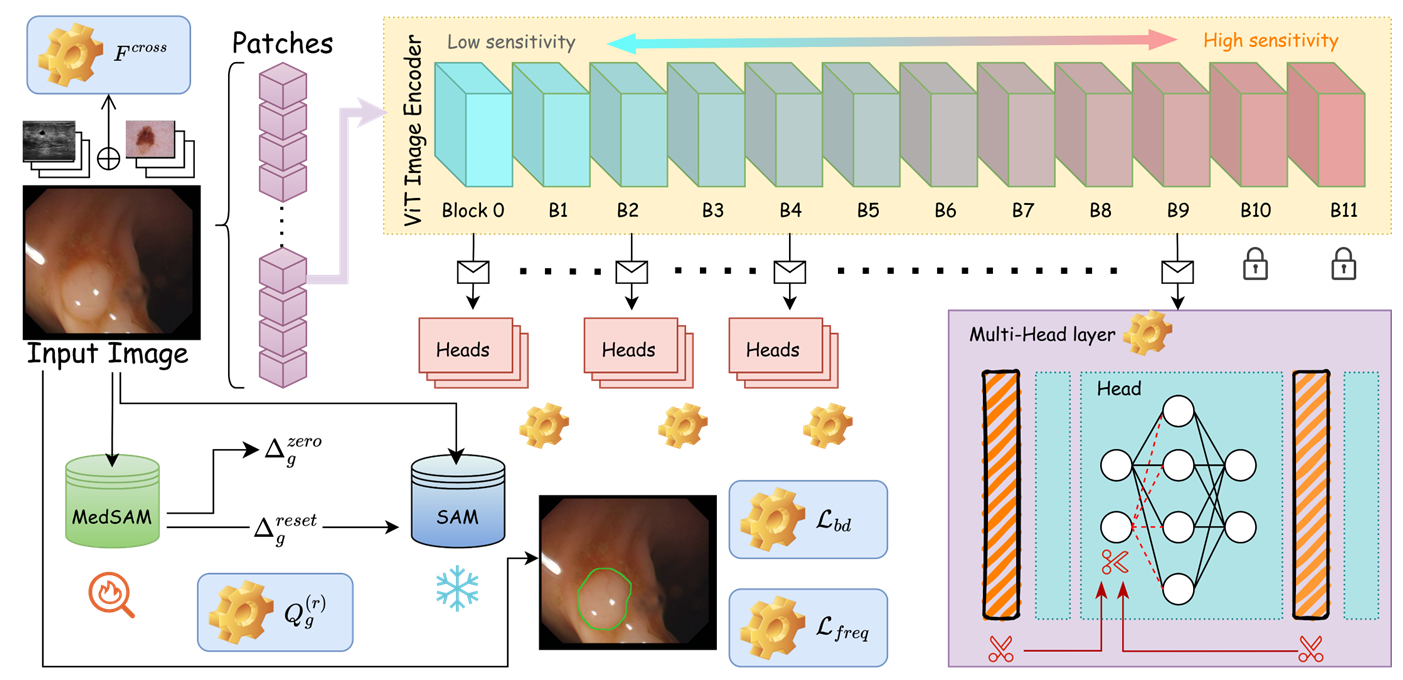
- MedCore: Boundary-Preserving Medical Core Pruning for MedSAMCenwei Zhang, Suncheng Xiang†, and Lei You†arXiv preprint arXiv:2605.13688, 2026
Medical segmentation foundation models such as SAM and MedSAM provide strong prompt-driven segmentation, but their image encoders are still too large for many clinical settings. Compression is also risky in medicine because a model can keep high Dice while losing boundary fidelity. We propose MedCore, a structured pruning framework for MedSAM. The main idea is to preserve two kinds of structures: structures that became important during SAM-to-MedSAM adaptation, and structures that have high boundary leverage. We identify the first type by a dual-intervention score that compares zeroing a group with resetting it to its original SAM weight. We identify the second type by boundary-aware Fisher estimation. We also introduce a boundary leverage principle, which shows that compression-induced boundary displacement is controlled by logit perturbation on the boundary divided by the logit spatial gradient. This principle explains why boundary metrics can degrade even when Dice remains high. On polyp segmentation benchmarks, MedCore reduces parameters by 60.0% and FLOPs by 58.4% while achieving Dice 0.9549, Boundary F1 0.6388, and HD95 5.14 after recovery fine-tuning. It also reaches 86.6% parameter reduction and 90.4G FLOPs with strong boundary quality. Our analysis further shows that MedSAM lies in a head-fragile boundary regime: head-pruning steps have 2.887 times larger 95th-percentile boundary leverage than MLP-pruning steps, and this logit-level effect is consistent with BF1 and HD95 degradation.
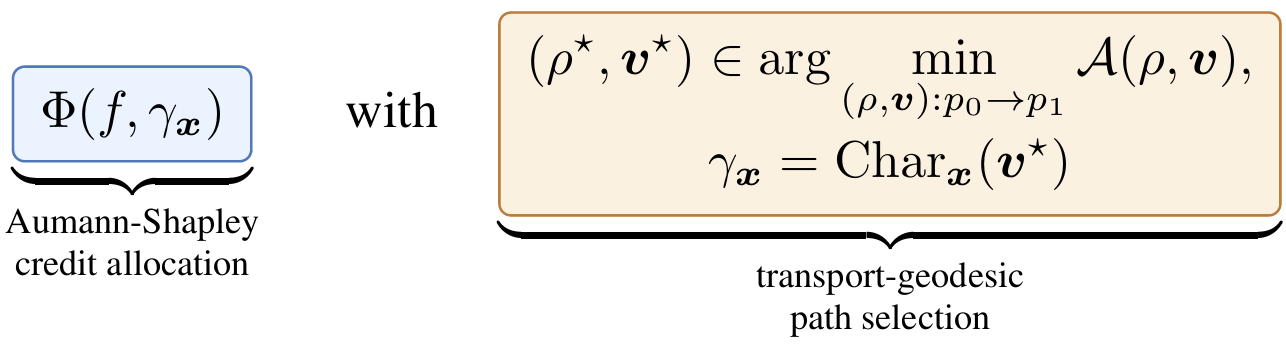
- From Baselines to Transport Geodesics: Axiomatic Attribution via Optimal Generative FlowsCenwei Zhang*, Lin Zhu*, Manxi Lin, and 1 more authorAnnual Conference on Neural Information Processing Systems (NeurIPS), 2026
Feature attributions often hide a critical modeling choice: they explain a prediction along a counterfactual path from a reference state to an input. Different baselines, interpolations, and generative trajectories define different paths and can therefore produce different explanations. We study this path ambiguity as a modeling problem. Our central question is whether the path can be chosen by the data-generating transport process, rather than by a hand-designed interpolation or by the sensitivity geometry of the model being explained. We separate attribution into fixed-path credit allocation and path selection. For a fixed path, we prove that the Aumann-Shapley line integral is the unique attribution rule under standard fixed-path axioms and explicit coordinate-trace regularity. For path selection, we minimize kinetic action over flows that transport a reference distribution to the data distribution, yielding a transport-geodesic attribution principle. We approximate this ideal with Rectified Flow and Reflow and derive stability bounds linking vector-field error to attribution error. Experiments show that lower-action, transport-consistent paths produce more stable and structured explanations, preserving competitive deletion faithfulness, without claiming data-manifold membership.